

![FKM VS FFKM [Header]](https://www.wyattseal.com/hs-fs/hubfs/Images/Blog%20Photos/FKM%20VS%20FFKM%20%5BHeader%5D.jpg?width=5322&height=3548&name=FKM%20VS%20FFKM%20%5BHeader%5D.jpg)
When reliable sealing is critical, selecting the right elastomer makes all the difference. Two of the most capable materials on the market—FKM (fluoroelastomer) and FFKM (perfluoroelastomer)—are often compared for their impressive chemical and temperature resistance. But while they share some similarities, the differences between FKM and FFKM can greatly impact performance, cost, and long-term reliability.
At Wyatt Seal, our team helps customers identify the ideal material for their specific application—whether that means optimizing for budget, chemical exposure, or performance under extreme conditions. Contact us today to discuss your sealing requirements and get expert guidance on selecting between FKM and FFKM O-rings or other precision seals.
What Is FKM?
FKM, commonly known under trade names like Viton®, is a fluoroelastomer designed for high-temperature and chemical-resistant sealing applications. It’s a go-to material in automotive, aerospace, and industrial systems because of its durability and broad compatibility with fuels, oils, and many chemicals.
Key advantages of FKM:
- Excellent resistance to fuels, oils, and hydraulic fluids
- Reliable performance up to approximately 400°F (204°C)
- Low compression set and good mechanical strength
- Cost-effective compared to FFKM O-rings or perfluoroelastomers
In short, FKM seals provide strong performance for many demanding environments without the higher price tag of perfluoroelastomers.
What Is FFKM?
FFKM, or perfluoroelastomer, represents the top tier of sealing materials. With a fully fluorinated polymer backbone, FFKM seals combine near-universal chemical resistance—similar to PTFE—with the elasticity and sealing performance of rubber.
Key advantages of FFKM:
- Withstands temperatures up to 600°F (316°C)
- Resistant to virtually all chemicals, including acids, amines, and solvents
- Exceptional performance in aggressive or high-purity environments
- Ideal for semiconductor, pharmaceutical, and chemical processing applications
While FFKM O-rings provide unmatched reliability, they come at a significantly higher cost. For applications that don’t require extreme chemical resistance, FKM materials may offer a better performance-to-cost balance.
FKM vs FFKM: Key Differences at a Glance
| Property | FKM | FFKM |
| Material Type | Fluoroelastomer | Perfluoroelastomer |
| Temperature Range | Up to 400°F (204°C) | Up to 600°F (316°C) |
| Chemical Resistance | Excellent for fuels, oils, many chemicals | Near-universal (including harsh acids and solvents) |
| Compression Set | Low | Very low |
| Cost | Moderate | High |
| Common Uses | Automotive, aerospace, industrial | Semiconductors, chemical processing, pharma |
Which One Is Right for Your Application?
The decision between FKM vs FFKM ultimately depends on your operating environment and performance priorities:
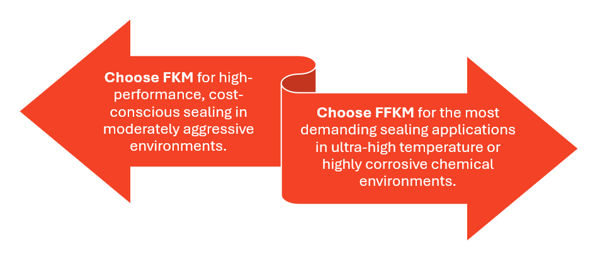
Engineers often find that FKM O-rings are sufficient for automotive, fuel system, or aerospace use, while FFKM seals dominate in cleanroom, chemical, and high-purity manufacturing settings.
If you’re unsure which material suits your needs, you don’t have to decide alone.
Partner with Wyatt Seal for Expert Material Selection
From fluoroelastomer O-rings to perfluoroelastomer seals, Wyatt Seal helps engineers and manufacturers choose the right material for every environment. Our technical team can evaluate your requirements and recommend a sealing solution that balances chemical resistance, temperature performance, and longevity.
If you need help navigating this process to find the right seal for your project, talk to a seal expert at Wyatt Seal. We’ve spent 50 years building relationships with seal manufacturers worldwide to offer you access to thousands of seals, gaskets, O-rings, and other specialty items for any application.